The Government of India imposes import curbs on certain platinum jewellery
November 18, 2025
Royal Canadian Mint’s opulence Collection returns with Platinum and Gold coins featuring yellow diamonds
November 19, 2025Strengthening India-Africa partnership
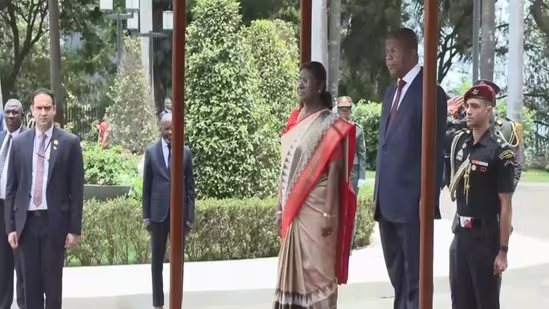
President of India, Droupadi Murmu landed in Luanda, earlier on Sunday,16 Nov.2025.

(Authored by Prabhu Dayal, former ambassador, New Delhi)
President Droupadi Murmu’s recent visit to Angola and Botswana was historically significant as the first-ever State visit by an Indian Head of State to these nations, marking a milestone in bilateral relations and a strategic effort to deepen India’s multifaceted partnership with the African continent. The visit demonstrated that India’s engagement with Africa is a multidimensional relationship, evolving from historical solidarity to a modern strategic partnership critical for India’s sustained economic growth and its aspirations for a greater role on the global stage.
President Murmu visited Angola from November 8-11, 2025 at the invitation of President João Manuel Gonçalves Lourenço and participated in the celebrations of Angola’s 50th anniversary of independence. High-level talks were held to review cooperation in trade, investment, agriculture, health, infrastructure, and defence. Both nations agreed to partner in critical areas, including renewable energy, wildlife management, and the Global Biofuel Alliance (GBA). The visit consolidated decades of friendship rooted in anti-colonial solidarity and built a modern, multidimensional partnership for the 21st century
The discussions included finalising a $200 million Line of Credit to Angola to support its defence capacity and potential collaboration in modern railway development, demonstrating a commitment to supporting Africa’s infrastructure and security needs. Several Memoranda of Understanding (MoUs) were exchanged, notably to strengthen cooperation in sustainable fisheries, aquaculture, marine resources, and consular matters. Angola agreed to join two significant India-led initiatives: The International Big Cat Alliance (IBCA) and the GBA. Discussions on an Air Service Agreement were concluded, which could enable future direct flights between the two countries and boost business and people-to-people ties.
President Murmu addressed the Angolan National Assembly, highlighting the shared values of democracy and the historical linkages from anti-colonial struggles. A significant part of the visit involved President Murmu participating in the celebrations of Angola’s 50th anniversary of independence, which coincided with the 40th anniversary of formal diplomatic relations between India and Angola. The visit highlighted strong economic relations, with bilateral trade crossing the $5 billion mark the previous year. Angola is an important partner in India’s energy security, and India is one of Angola’s top trade partners.
In the second leg of the visit, President Murmu visited Botswana from November 11 to 13, 2025. President Murmu and her Botswana counterpart, President Duma Gideon Boko, held comprehensive talks covering trade, investment, agriculture, renewable energy, health, education, defence, and digital technology. A significant event was the symbolic handover of eight cheetahs from Botswana to India under the next phase of Project Cheetah, highlighting shared commitments to wildlife conservation. The two leaders witnessed the signing of an agreement on pharmacopoeia, which will facilitate access to affordable Indian medicines in Botswana.
President Murmu addressed the National Assembly of Botswana, underscoring shared democratic values and a commitment to inclusive growth. She interacted with the 10,000-strong Indian diaspora in Gaborone, calling them a “living bridge of friendship” between the two nations. The President visited the Diamond Trading Company Botswana (DTCB) and was briefed on the importance of the diamond sector to the country’s economy.
The visit to Angola and Botswana underscored the shared democratic values and historical anti-colonial struggles that form the foundation of India’s relationship with these nations. The visit is reflective of India’s firm commitment to expanding its partnership with Africa within the framework of South-South cooperation and the India-Africa Forum Summit and sets a positive tone for future engagements. The visit served to consolidate a partnership rooted in mutual respect, shared values, and a roadmap for future collaboration anchored in innovation, inclusivity, and shared aspirations.
India’s outreach to Africa is significant due to its strategic importance, economic benefits, and role in building a sustainable, South-South model that emphasises capacity building and shared growth. The relationship provides India with a strategic partner in the Indian Ocean region, access to Africa’s resources, and a diversified market for trade and investment. For Africa, India offers a distinct partnership model that focuses on local ownership, transparency, and empowerment through initiatives in technology, health care, and infrastructure.
India’s engagement is partly a response to China’s extensive influence in Africa. India offers an alternative development model that emphasises transparency, local capacity building, and demand-driven assistance, contrasting with the large-scale, sometimes debt-intensive, infrastructure projects associated with China’s Belt and Road Initiative. India’s outreach is crucial for its maritime security strategy in the Indian Ocean, a vital area for trade and energy security. Collaboration on maritime security and anti-piracy efforts is a key component.
By supporting Africa’s role on the global stage, such as by advocating for the African Union’s entry into the G20, India enhances its own position and the collective influence of the Global South. India aims to foster a model of cooperation that is less dependent and more dependable, built on trust and shared values, differing from historical colonial models. The relationship is built on historical solidarity and shared experiences during the anti-colonial struggle, which continues to provide a strong foundation of goodwill. A large Indian diaspora in East and Southern Africa strengthens cultural understanding and facilitates trade networks and soft power. India’s emphasis on development through capacity-building, rather than economic coercion, is often viewed as a distinct and positive approach.
India’s outreach is a multi-layered approach aimed at fostering a sustainable, mutually beneficial partnership that aligns with Africa’s own aspirations for self-directed development, while simultaneously advancing India’s own strategic global interests. Africa, with its large and youthful population, rich natural resources, and growing markets, offers immense potential for economic collaboration. Bilateral trade has been growing steadily, with India becoming Africa’s third-largest trading partner. Key sectors for collaboration include pharmaceuticals, automobiles, technology, and agriculture. Africa is a critical source for natural resources and energy needs, including oil from Nigeria and Angola, and vital minerals like cobalt and manganese needed for India’s clean energy transition and manufacturing ambitions.
The road ahead requires India to develop a focused, long-term strategy that moves beyond transactional aid to a comprehensive, investment-led partnership that aligns with Africa’s own development agenda, “Agenda 2063: The Africa We Want”. By focusing on local capacity, sustainable growth, and timely project delivery, India aims to position itself as a reliable and equitable partner in Africa’s transformative journey. From this viewpoint, President Murmu’s visit was significant for expanding India’s strategic footprint and partnerships in Africa.