


AI is bringing a new twist to the traditional jewellery industry!
February 21, 2026The Silver Renaissance How scarcity, demand, and voatility are establishing silver as one of the world’s most indispensable metals
Ahmed bin Sulayem
Feb 20
For decades, silver lived in the long shadow of its yellow sibling. Within the context of global finance, gold was the undisputed king and the ultimate hedge against the systemic frailties of fiat currency. Silver, by contrast, was often dismissed as its volatile relative, prone to wild swings, treated as a byproduct, and relegated to the periphery of institutional portfolios. Today, that narrative is changing.
As of mid-February 2026, the silver market has completed a clear transition from a cyclical precious metal to a structurally scarce strategic asset. This industrial renaissance is evident in the hard evidence of supply and demand, as illustrated by a 95-million-ounce deficit in 2025, marking the fifth consecutive annual shortfall. For the period between 2021 and 2025, the cumulative deficit reached nearly 820 million ounces, a figure that remarkably exceeds an entire year’s worth of global mine production, and has subsequently forced the market to cannibalise above-ground reserves to bridge the gap. With the Silver Institute’s February 2026 outlook now confirming a sixth consecutive deficit of 67 million ounces on the horizon, the market has entered an era of persistent structural undersupply.
The 2026 Market Pulse: Volatility and the Paper Reset
The start of 2026 has been defined by extreme swings and technical resets. After surging to a record high of USD 121.60 per ounce on 29 January, silver experienced a significant correction. By mid-February, prices stabilised near USD 80 per ounce, while in India, silver moved near ₹2.75 lakh per kilogram following dramatic fluctuations. A primary catalyst for this shift was the Warsh Shock on 30 January 2026, when President Trump nominated perceived inflation hawk, Kevin Warsh, as Federal Reserve Chair. While Warsh does not take office until May, the market immediately moved to price in Warsh’s ‘Monetary Barbell’ philosophy, a strategy that simultaneously eases rates while aggressively draining liquidity via balance sheet reduction. By signalling an end to the era of Fed enabled fiscal deficits, his nomination thus triggered an unwinding of the debasement trade, resulting in a 33 per cent intraday wipeout in silver leveraged paper positions.
The Gold-Silver Ratio: A Generational Signal
As a primary indicator of relative value, the Gold-Silver Ratio has served as a useful barometer for calculating future trends. For example, in April 2025, the ratio reached an extreme of 105.85, signal. Historically, ratios above 80:1 have preceded explosive silver rallies, and as the secular bull run was confirmed in late 2025, capital seeking refuge poured into the smaller silver market. The result was a masterclass in leverage, and while gold rose a respectable 7 per cent in late November, silver surged nearly 19 per cent, outperforming gold by a factor of 2.5 and closing the ratio gap with breathtaking speed. By late January 2026, the ratio collapsed to a multi-year low of 43.80 before rebounding above 60 in mid-February. In prior bull-market extremes, such as 2011, the ratio compressed to 30:1. With this in mind, and gold having traded at record highs of USD 5,600 per ounce, a return to such levels would imply silver prices could exceed USD 160 per ounce.
The Industrial Imperative: Energy, AI, and the EV Shock
Silver possesses the highest electrical and thermal conductivity of any element on the periodic table, a physical reality that makes it an irreplaceable industrial input inelastic to price. In the energy sector, the shift from older technology to Tunnel Oxide Passivated Contact and Heterojunction solar cells has increased silver consumption per panel by 30 per cent to 50 per cent. As the world races toward Net Zero, manufacturers are realising that the cost of lower efficiency far outweighs the cost of silver. This is most notably shown in the automotive industry where a battery-powered vehicle requires roughly double the silver of its combustion engine counterpart. Taken one step further, a potential demand shock looms with the advent of new technology, such as Samsung’s silver-carbon anode prototypes for solid-state batteries, which may use one kilogram of silver per 100 kWh battery pack. Put in context, even if ten million premium electric vehicles adopt this technology, they would consume nearly 40 per cent of global mining output before accounting for solar or electronics.
The Pharmaceutical Frontier: Combatting Antimicrobial Resistance
Beyond energy and transport, silver’s antimicrobial properties have created a silent but critical pillar of strategic demand. With the WHO 2026 framework tracking progress against superbugs, silver nanoparticles are now vital for treating resistant strains like MRSA. Consequently, the market for these nanoparticles is projected to rise to USD 16.8 billion by 2035, further supported by new U.S. production incentives and tariffs on pharmaceutical imports intended to accelerate the reshoring of supply chains.
Supply Realities: Geopolitical Choke Points and Critical Status
As mentioned earlier, the supply side remains structural and inelastic, as approximately 80 per cent of silver is produced as a byproduct of lead, zinc, and copper mining. Following the 2011 silver crash, mining companies slashed exploration budgets, and because it takes over a decade to bring a new mine to production, today’s high prices can only incentivise the supply of the mid-2030s. Exacerbated by geopolitical choke points and falling ore grades, China has consolidated control by authorising only 44 companies to export silver since the start of 2026, while the United States has officially added silver to its critical minerals list to pave the way for strategic stockpiling.
Inventory Crunch: The Paper vs. Physical Disconnec
The fragility of the current system lies in the disconnect between paper and physical silver, and while London markets trade more than a year’s worth of global mining output in paper silver every day, the actual physical availability is dwindling. As of early 2026, London vaults held roughly 892 million ounces, but only 155 million were estimated to be free float, i.e., available for settlement.
With that being said, we must cast a sceptical eye on reported data. The LBMA has a documented history of accounting issues, such as the May 2021 incident where they over-reported holdings by 3,300 tonnes. In a market dominated by unallocated accounts, it would be prudent to consider the buffer as an illusion. All it would take is for a single sovereign entity like Saudi Arabia or China to demand physical delivery at contract expiry to trigger an unprecedented run on silver, leading some speculators to believe the vault drain isn’t just a trend, but a countdown. Case in point, silver inventories on the Shanghai Futures Exchange have already plunged to near 10-year lows resulting in a USD 10 per ounce premium over Western prices.
To address this widening disconnect and provide reliable market access, DMCC’s wholly owned derivatives and spot exchange, the DGCX, offers silver futures for hedging purposes, as well as physical silver bars for those seeking direct exposure. This is further supported by additional infrastructure including the Dubai Commodities Clearing Corporation (DCCC), and DMCC’s in-house, approved vaults, which ensure that market participants have a secure bridge between paper contracts and the underlying metal.
Dubai’s Strategic Foresight: Tokenisation and Physical Certainty
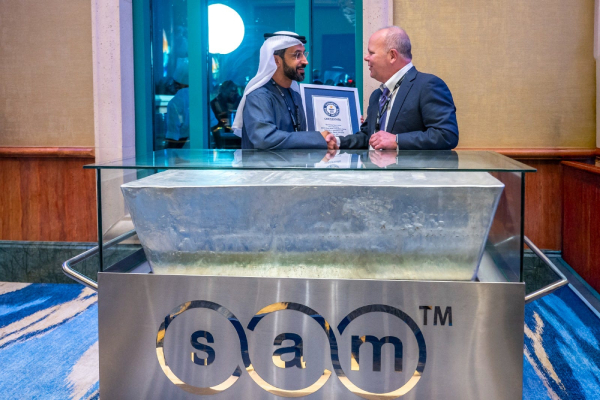
In Dubai, DMCC has been working towards modernising silver’s narrative through strategic foresight and digital innovation. The unveiling of a world-record 1,971 kg silver bar was not just a physical spectacle, but a calculated signal to position Dubai at the heart of the trade. Through partnerships with Tokinvest and Tradeflow, DMCC is enabling the tokenisation of precious metals, allowing for fractional ownership of audited physical metal via blockchain. This infrastructure combines the ancient security of the metal with the liquidity of the digital age, providing physical certainty in an era of fast-paced trade.
Based on its trading history and market outlook, silver is no longer just a commodity, but a strategic necessity bridging monetary preservation to a high-tech future, proving that it is not just a follower of gold, but a leader in its own right. As a result, it is also an asset worthy of its own untethered speculation, and one DMCC is proud to provide access to through its future-focused partnerships.

